




Week 1
Map your billing.
- YouShare pricing rules and sample invoices
- YouProvide access to operational and cost data
- WeMap billable events, costs, surcharges and exceptions
Billr prices everything your systems record, from warehouse services to API calls, against each customer's own contract. Where you have a cost, it sits next to the price. Finance gets invoice-ready lines, your team gets its month back.
Book 30 minutesA 30-minute call about your billing. Free, no contract, no obligation.
Pick your business. Each page shows how Billr handles your rate cards, your costs and your month-end.
Every order priced, every margin visible.
See how it works
Prepaid balances, token costs and margin per customer, priced as requests arrive.
See how it works
Several providers in. One invoice per customer out.
See how it works
Every session priced, every roaming cost visible.
See how it works
Another industry? Write to hello@billr.io.
AI assistant
Copy one page from Billr into Claude, ChatGPT, Cursor or any assistant that can call an API. From then on it reads your customers, charges, price lists, bills and analytics directly, with the permissions of your own user.
Which customers were under 15 % margin in September?
Three of 41 customers were below 15 % in September. All three are on the 2025 rate card and ship mostly to zone 3:
| Customer | Revenue | Margin |
|---|---|---|
| Northwind Outdoor | €48,210 | 11.4 % |
| Harbour Supplies | €31,905 | 12.9 % |
| Atlas Home | €17,330 | 14.2 % |
Source: Billr analytics, revenue and margin by customer, 1 to 30 September
Why did Northwind's invoice go up 18 % compared to August?
Volume is flat (+2 %). The increase comes from two things: 312 shipments moved from zone 2 to zone 3 after their new warehouse opened on 9 September (+€5,140), and the fuel surcharge rose from 9 % to 12 % on 1 September (+€1,870).
Source: 4 GraphQL queries on charges and price lists, 2 seconds
Prepare a 3 % increase for Northwind from 1 January, I will review it.
Done. Draft price list "Northwind 2027" is ready for your review in Billr, valid from 1 January 2027, 86 prices, zone 3 surcharge kept as is. Nothing is published until you approve it.
The same month, with and without Billr.
 Without Billr |  With Billr | |
|---|---|---|
| Prices | A spreadsheet per customer, one person knows it | Price lists per customer with validity dates, anyone can look up any date |
| Supplier price change | Edited customer by customer, some forgotten | Updated once, every customer price follows its markup rule |
| Month-end | Days of exports and reconciling | Priced all month, the run is checked and approved in an afternoon |
| Margin | A total at month-end, per customer at year-end | Per customer and service, every day |
| A customer asks why | Someone searches three systems | A line-by-line report comes with every invoice |
| A wrong price | Credit note by hand, history lost | Credited and re-priced with a preview, originals kept |
Billing shouldn’t take you months to implement
Week 1
Week 2–3
Week 4

“Using this platform has been a game-changer. It handles different pricing models seamlessly.”

Nolan Rook
CTO at Ecomflow

“Rethink your processes. Rethink your pricing. Billr gives you the freedom to model and price anything you can imagine.“

Lutz Prosser
CFO at Quivo
A look inside
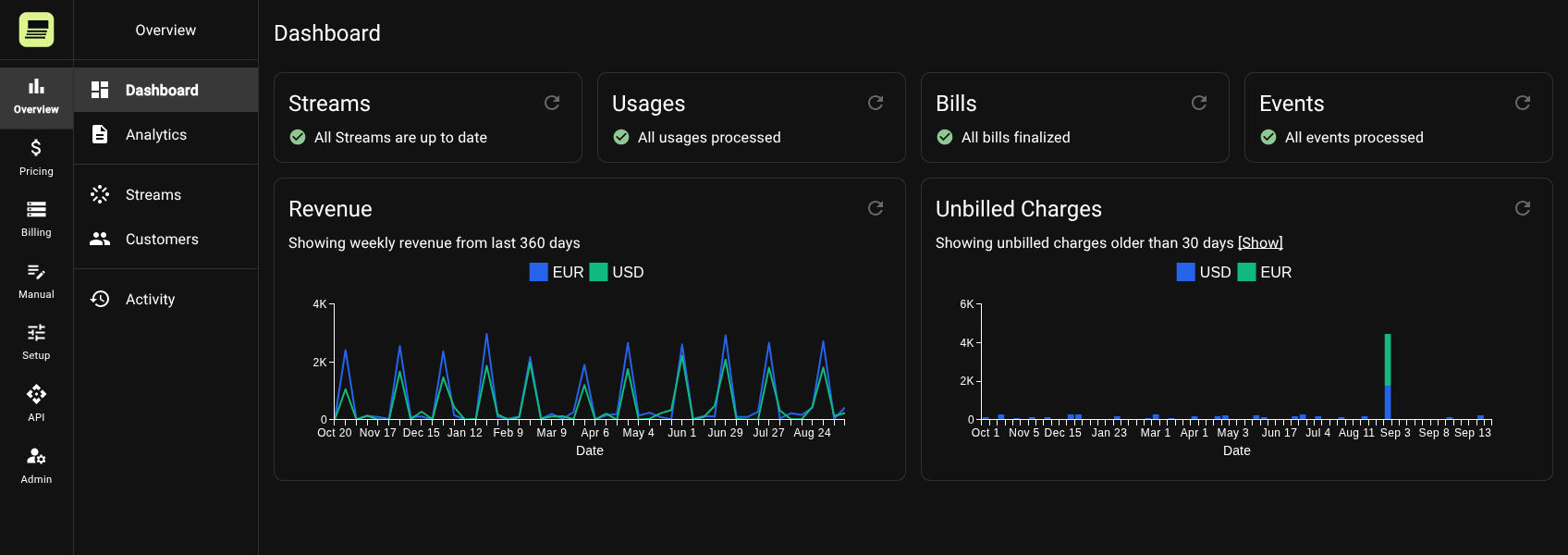
Every data source up to date, every usage processed, every bill finalised. Revenue per week, unbilled charges older than 30 days.
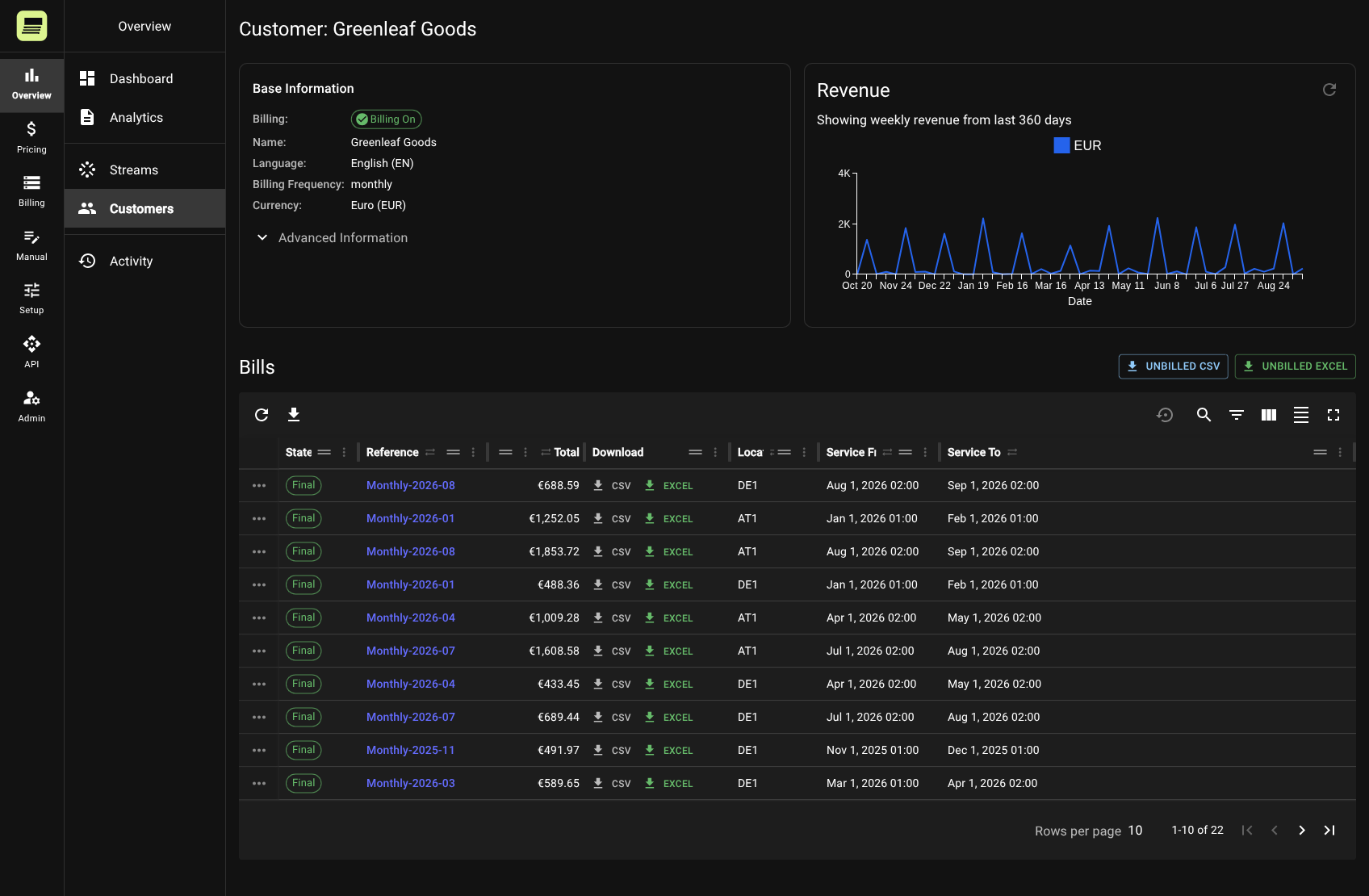
Billing settings, revenue over the year and every bill with its CSV and Excel report, ready to send.
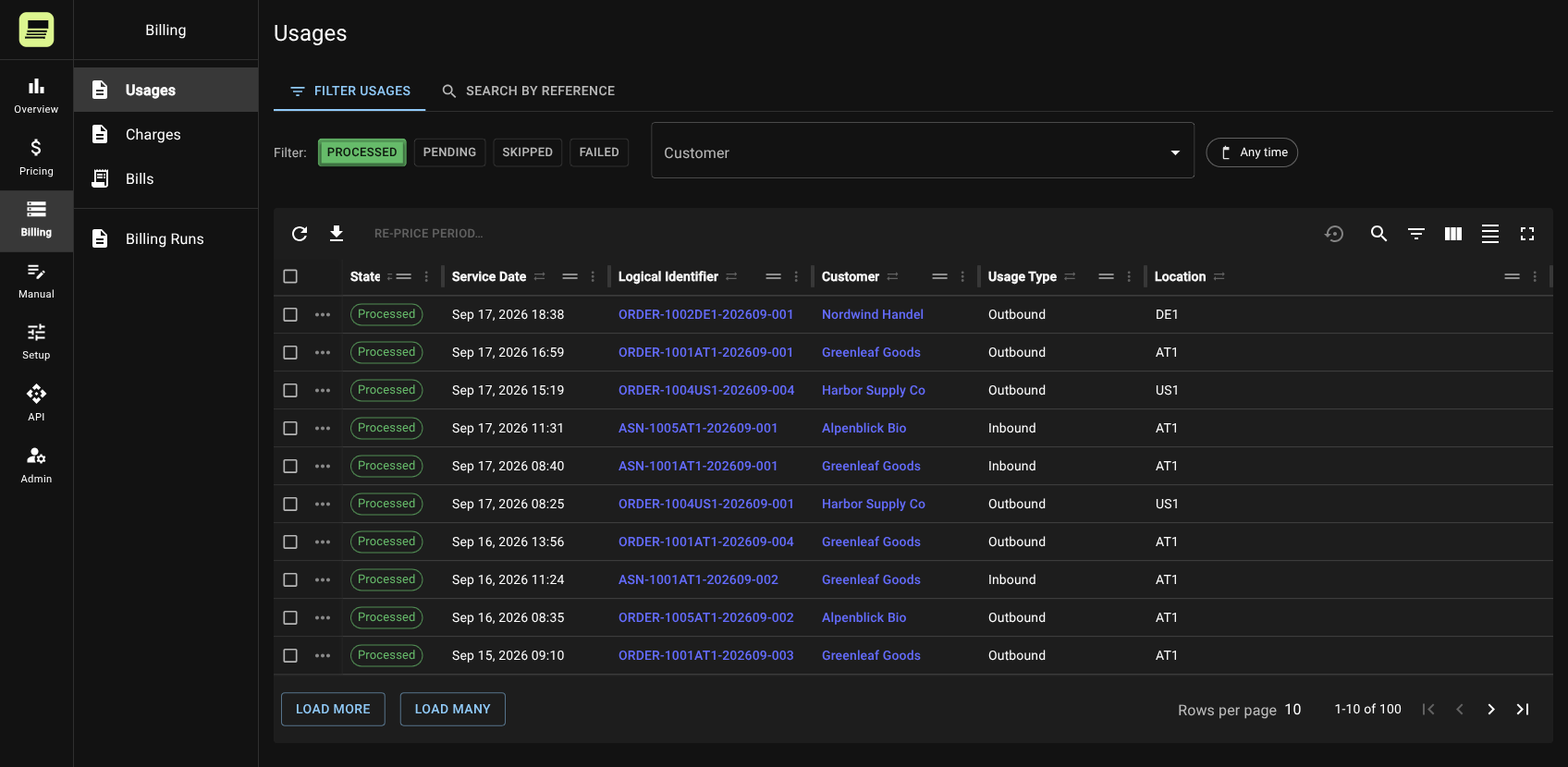
Processed, pending, skipped or failed with the reason. Search by order number or tracking reference.
Handle customer-specific rates, surcharges, exceptions and integrations without forcing your operations into a standard billing model.
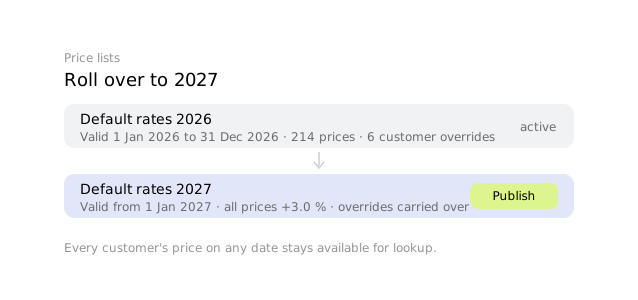
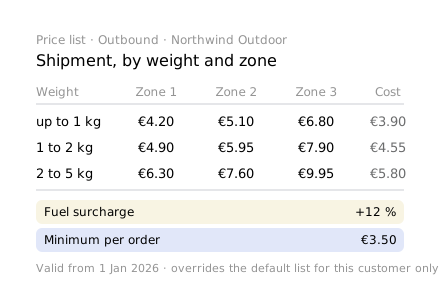
Update rates, surcharges and customer overrides from a date you choose, run the yearly increase across every customer in one step, and look up what any customer paid on any day.
Volume tiers, rate tables by weight and zone, free allowances, minimums, surcharges, customer overrides and exceptions. Priced from price lists with validity dates, not from spreadsheets.
Send operational, shipping and cost data through the Billr API, scheduled imports or file exports, and hand invoice lines to your accounting tool. Not on the list? It is built during your setup.
Warehouse and operations
Accounting and invoicing
Payments and data
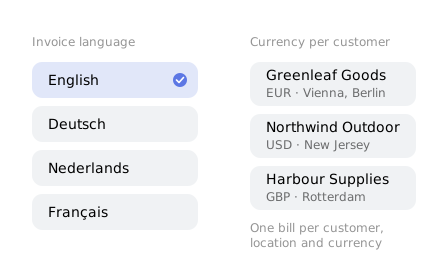
Invoice lines in the customer's language and currency, one bill per customer, location and currency, handed to Xero, Stripe, QuickBooks, DATEV or the tool you invoice with today. Peppol e-invoicing included through them.
Controls
Billing software is judged on the month it goes wrong. These are the rules Billr enforces so that month does not happen.
Send an event as often as you like. Billr stores it once under its ID, keeps its order or session reference, and it can only ever be billed once.
A run does not start until every data source has delivered up to the period end and no errors are waiting. Nothing goes out until you approve it.
Numbers are assigned when a bill is finalised, in sequence, one bill per customer, location and currency. No holes to explain to the auditor.
A credit reverses the revenue, with or without the cost. A corrected event credits the old charges and bills new ones. The originals stay.
After a price change, see the difference per customer for a selection or a whole period before anything is applied.
Field-level history on prices, price lists, mappings and overrides, plus who started and who approved every billing run.
Every customer runs in its own environment in the EU (AWS Ireland), with its own database, its own users and invite-only access.
From your first customers to millions of billable events, Billr scales without changing your billing infrastructure.
Send operational events from your WMS, platform or gateway through the documented Billr API or scheduled imports. Each event is priced within seconds of arriving. The same API answers any question your team or your AI assistant asks.
mutation {
  upsertUsage(
    id: "ORDER-48112"
    usageTypeId: "OUTBOUND"
    customerId: "northwind"
    locationId: "HAM-1"
    serviceDate: "2026-10-16T09:41:00Z"
    data: { pieces: 3, weightKg: 1.8,
            zone: "EU3", carrier: "DHL" }
    references: [{ typeId: "tracking",
                   value: "JD0148112AT" }]
  ) { id }
}query { listCustomers(limit: 5) { items { id name } } }Probably. Billr fits any business that bills many customers for what they use, at customer-specific prices, with a cost behind each unit. The four pages are where we have customers or active work. If yours looks different, write to hello@billr.io and describe how you bill today.
A monthly platform fee plus a usage fee priced per thousand charges, so the usage part stays a fraction of a cent per priced line. You get a concrete number on the first call, once we know your volume. There is no implementation project to buy first.
No. Billr reads events from the systems you already run, whether that is a WMS, a charging backend or an API gateway, through its API, scheduled imports or file exports. It prices them and hands invoice lines to the tool that already sends your invoices. Nothing in your operation changes.
About four weeks. Week one we map your pricing from your rate cards and invoices, weeks two and three we configure Billr and run it next to your current billing, week four you bill with it.
Billr produces the priced, auditable invoice lines and the line-by-line report per customer. Xero, Stripe, QuickBooks, DATEV or whatever you invoice with today sends the invoice, so your numbering, layout and e-invoicing stay where they are.
Only your users. Every customer runs in its own environment in the EU with its own database, invite-only access and roles. An AI assistant you connect acts with the permissions of the user who connected it, nothing more.
If you want, you send us one customer's invoice and the data behind it, and we return that month priced in Billr with a short write-up. If you do not like what you see, nothing happens. No contract is involved at any step.
Who you talk to
Billr is made by Kandu, a Vienna software company that has built systems for high-volume operations since 2015: warehouse management, the integrations between shops, warehouses and carriers, and the billing behind them.
Kandu built Billr in 2024 for a logistics customer whose spreadsheets could no longer price its volume. It became a product when the next company asked for the same thing. It bills more than €100M a year today, and the engine that prices shipments prices API calls, SIM usage and charging sessions the same way. Behind it: a small engineering team in Vienna and a company that has been profitable every year since it started.
The 30-minute call is with Dominik Bieringer, the founder. He has been on the operations side of usage-based billing himself, and he is the person who decides what Billr builds next.
Dominik Bieringer
Founder
The first step
You do not need a project, a budget or a decision to find out what Billr would change for you. You need half an hour.
You show us how you bill today: your systems, your price lists, where the month goes wrong. We tell you on the call what Billr would do with it, and what it would not.
One customer, one month: send us the invoice and the data behind it. You get it back priced in Billr, matched against your invoice, with the breakdown behind every line and the analytics on top: volumes, revenue, margin.
A short document: what matched, what differed and why, what we found in the numbers, and what a setup would involve. No contract, nothing to install, nothing to prepare.
If you do not like what you see, you say no. That is the whole risk.