Week 1
Map your billing.
- YouShare pricing rules and sample invoices
- YouProvide access to operational and cost data
- WeMap billable events, costs, surcharges and exceptions
Billr meters your API traffic, prices each request against the customer's plan and model, keeps the provider cost next to it, and runs prepaid balances, overages and invoices. You keep building the product.
Book 30 minutesA 30-minute call about your billing. Free, no contract, no obligation.
The same month for an API business, with and without Billr.
 Without Billr |  With Billr | |
|---|---|---|
| Metering | Counters in the gateway, exported to a sheet | Every request priced per customer and model as it arrives |
| Provider price change | Margins shrink until someone notices | Cost updated from that date, customer prices repriced by rule |
| Prepaid customers | Run out and find out when requests fail | Alert at 80 percent, stop at 100 percent, top-up credited |
| Enterprise exceptions | Hard-coded in the product | A customer override in Billr, valid from a date |
| Month-end | Invoices built from logs by hand | Invoice lines per customer, prepaid and overage on one statement |
| A customer asks why | An engineer queries the logs | A report per model and day behind every amount |
AI assistant
Copy one page from Billr into Claude, ChatGPT, Cursor or any assistant that can call an API. From then on it reads your customers, charges, price lists, bills and analytics directly, with the permissions of your own user.
Which customers will run out of credits before Friday at the current burn rate?
Four accounts. Two of them are on the enterprise plan and have auto top-up disabled:
| Customer | Balance | Runs out |
|---|---|---|
| Lumen Labs | $1,240 | Wed 14:00 |
| Orbit Analytics | $880 | Thu 09:00 |
| Quill AI | $310 | Thu 18:00 |
| Pixelforge | $95 | Tonight |
Source: Billr balances and the last 7 days of charges per customer
What is our margin on reasoning models this month, per provider pool?
23 % overall. Pool A (annual commitment) runs at 31 %, pool B (pay as you go) at 9 %, because 60 % of long-context requests were routed there after 12 October.
Source: Billr analytics, cost and margin by model and provider pool
Draft a price list for Lumen Labs with 10 % off output tokens from 1 November.
Draft "Lumen Labs Nov 2026" is ready in Billr: output tokens -10 % on all models, input and cached tokens unchanged, valid from 1 November. Review and publish when you are ready.
Billr sits next to your gateway, prices every request against the customer's plan, and shows you cost and margin on each one.
Send usage events from your gateway or proxy, in real time or in batches. Billr prices each request per customer, model and tier within minutes, and reports it per API key, team or project. Billr never sits in the request path.
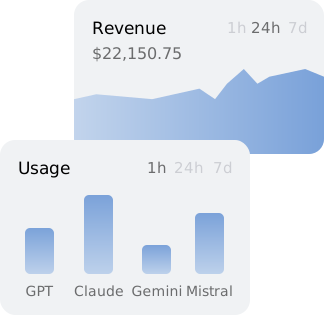
Customers buy credits upfront or get a monthly limit. Billr draws the balance down per request, alerts them and you at 80 percent, and tells your gateway to stop at 100 percent until the next top-up.
Load the OpenAI, Anthropic and Google price sheets, set your markup per model, and publish your own price list. Billr keeps what each request cost you and what the customer paid. Margin per customer, model and provider pool, so you know which accounts lose money before the month is over.
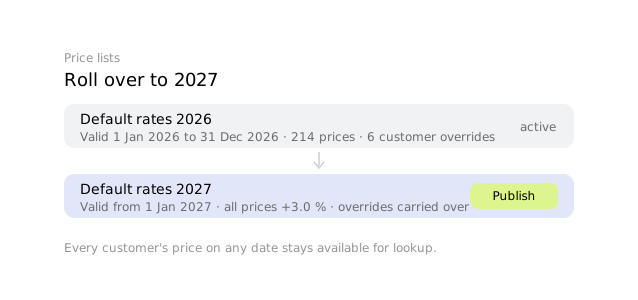
Per-model rates, markups, free allowances, minimums and enterprise exceptions live in Billr, not in code. Change them from a date, for one customer or for all of them, and test the new price on last month's real usage before any customer sees it.
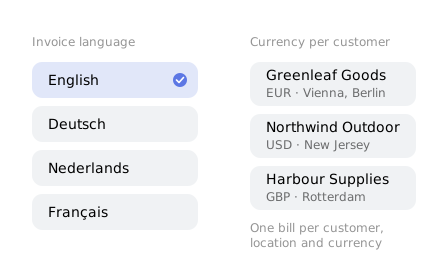
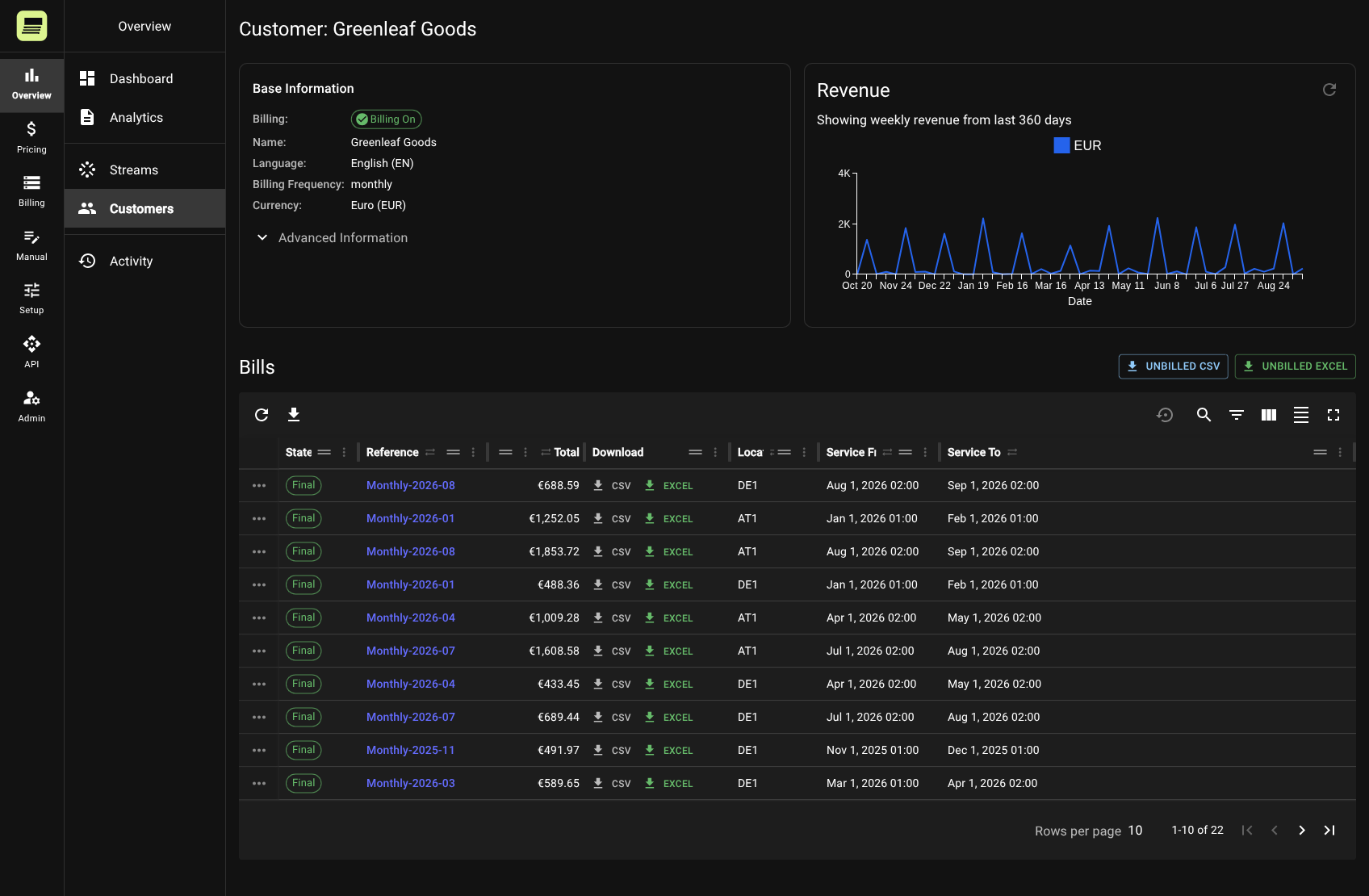
Monthly invoice lines per customer in their currency, prepaid top-ups and overages on the same statement, and an audit trail from every amount back to the requests behind it.
Each invoice carries a line-by-line report down to the requests behind every amount, per model and per day. Fewer support tickets, and no argument at month-end.
Billr works from the events your gateway already logs.
| Your gateway sends | Billr returns |
|---|---|
| A request: customer, model, input and output tokens | A priced line with the customer rate, your provider cost and the margin |
| A top-up payment | Balance credited, alert thresholds re-armed |
| Balance reaches zero | A webhook to your gateway to pause the account |
| A new provider price list | Cost updated on every request from that date, customer prices repriced by rule |
| A pricing idea | Last month's usage priced both ways, the difference per customer shown before you decide |
| Month-end | Invoice lines per customer, prepaid and overage on one statement |
Billing shouldn’t take you months to implement
Week 1
Week 2–3
Week 4
Controls
Billing software is judged on the month it goes wrong. These are the rules Billr enforces so that month does not happen.
Send an event as often as you like. Billr stores it once under its ID, keeps its order or session reference, and it can only ever be billed once.
A run does not start until every data source has delivered up to the period end and no errors are waiting. Nothing goes out until you approve it.
Numbers are assigned when a bill is finalised, in sequence, one bill per customer, location and currency. No holes to explain to the auditor.
A credit reverses the revenue, with or without the cost. A corrected event credits the old charges and bills new ones. The originals stay.
After a price change, see the difference per customer for a selection or a whole period before anything is applied.
Field-level history on prices, price lists, mappings and overrides, plus who started and who approved every billing run.
Every customer runs in its own environment in the EU (AWS Ireland), with its own database, its own users and invite-only access.
No. Your gateway or proxy keeps handling requests and sends Billr usage events, in real time or in batches. Billr is never in the request path and cannot add latency or downtime to your API.
Yes. Cost is tracked per provider pool, so a request served from a cheaper pool shows the right cost and the right margin.
The metering, pricing, cost and invoicing engine runs in production and bills more than €100M a year. The prepaid balance, threshold alerts and the pause webhook are the first things we build with our first AI customer, on top of that engine, within the four-week setup.
Billr produces the amounts, balances and invoice lines. Collecting the money stays with Stripe or your payment provider, and top-ups flow back into the balance.
About four weeks. Week one we map your plans and a sample of usage, weeks two and three we configure and run Billr next to your current billing, week four you bill real customers with it.
Your team, in Billr, from a date you choose. When you need a pricing model Billr does not have yet, we build it with you.
The first step
You do not need a project, a budget or a decision to find out what Billr would change for you. You need half an hour.
You show us how you bill today: your systems, your price lists, where the month goes wrong. We tell you on the call what Billr would do with it, and what it would not.
One customer, one month: send us the invoice and the data behind it. You get it back priced in Billr, matched against your invoice, with the breakdown behind every line and the analytics on top: volumes, revenue, margin.
A short document: what matched, what differed and why, what we found in the numbers, and what a setup would involve. No contract, nothing to install, nothing to prepare.
If you do not like what you see, you say no. That is the whole risk.